
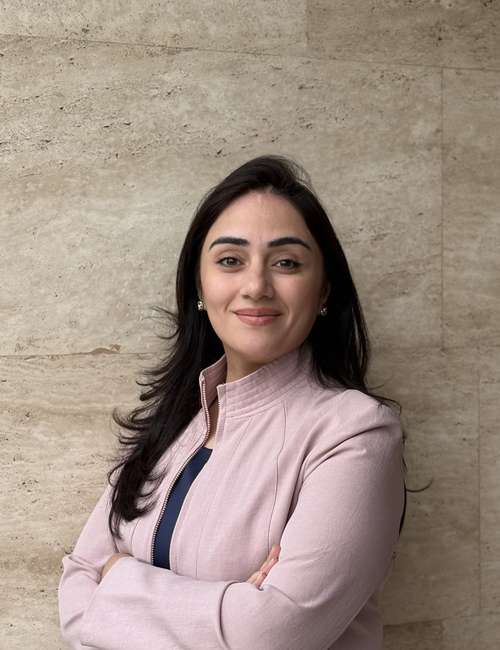
Academic Staff

May 13, 2026, 11:19 p.m.
Lureen Ibrahim Naser (PhD)
None
Assistant Professor in Applied Linguistics

English Language
College of Basic Education
University of Duhok

  • PhD in Applied Linguistics, College of Languages,University of Dohuk, 2023.
  • MA in Linguistics and Applied Linguistics, University of Duhok, College of Arts, Department of English Language, 2011.
  • BA in English Language, University of Duhok, College of Education, Department of English Language, 2006.

I have over a decade of experience teaching students in the Department of English, with a focus on fostering strong communication skills and linguistic competence. I have taught a wide range of courses, including Phonetics & Phonology, Listening & Speaking, Essay Writing, Grammar, and General Linguistics. My teaching philosophy emphasizes student engagement, active learning, and the creation of a supportive and inclusive classroom environment. I regularly integrate technology and pedagogical tools, including educational games and digital resources, to enhance learning outcomes and promote interactive, student-centered instruction.

Professional development is a fundamental component of academic growth, enabling educators to refine their pedagogical practices and deepen their subject expertise. My engagement in a series of workshops and specialized courses reflects a sustained commitment to advancing my teaching competencies, particularly in the field of English language education and linguistics.

My participation in the Professional Development Workshop organized by the US Embassy in Erbil (April 9–11, 2017) provided valuable exposure to contemporary educational strategies and cross-cultural academic exchange. This experience was further reinforced by completing a course in Teaching Methods for Higher Education at the Training and Development Centre in Duhok, where I developed a more structured and student-centered approach to instruction.

In addition, I have completed a sequence of professional courses through Coursera, offered by Arizona State University, under the “Teach English Now!” specialization. These courses—covering foundational principles, theories of second language acquisition, lesson design and assessment, and a capstone project—have significantly enhanced my understanding of language pedagogy. They provided both theoretical grounding and practical tools for designing effective learning experiences and evaluating student outcomes.

Moreover, my participation in the course “Miracles of Human Language: An Introduction to Linguistics” by Leiden University broadened my academic perspective on language as a complex human phenomenon. This course deepened my awareness of linguistic structures, diversity, and the cognitive aspects of language learning.

Overall, these professional development activities have contributed to strengthening my academic profile by integrating theory with practice. They have enabled me to adopt more innovative, reflective, and research-informed approaches in my teaching, ultimately improving the quality of education I provide to my students.

Research

  • The Interlanguage Phonology of Kurdish EFL Learners: Cases of Vowel Epenthesis, Consonant Deletion and Metathesis. M.A. Thesis. University of Duhok.
  • An Investigation of The Velar Nasal in Badini Kurdish Dialect. Humanities Journal of University of Zakho, 5(4), 1262-1268.
  • Instruction to Overcome The Difficulty in Acquiring English Segments Non-Existent in Kurdish, to Kurdish EFL Learners. Journal of Duhok University, 20(2), 94-119.
  • Effect of Initial /s/ on The Voice Onset Time (VOT) of Following Stops in Bahdini Kurdish. Journal of Duhok University, 26(1), 768-775.
  • A Contrastive Study of The Effect of Initial /s/ on the Voice Onset Time (VOT) of Following Stops in English, Kurdish and Kurdish EFL Learners. Journal Of Language Studies, 6(4, 1), 345-357.
  • Voice Onset Time (VOT) in Kurdish EFL Learners. In: Radek Skarnitzl & Jan Volín (Eds.), Proceedings of the 20th International Congress of Phonetic Sciences (pp. 634–638). Guarant International.
  • Teaching Speaking Using Games for Primary Public And Private School Pupils in Duhok. Journal of Duhok University, 26(2), 104-116.
  • The Effect of Speaking Rate on the Voice Onset Time (VOT) of Bahdini Kurdish Stops. Journal Of Language Studies,
  • A Contrastive Study of Voice Onset Time in Bahdini Kurdish and English. Ph.D. Dissertation. University of Duhok.

My research interests focus on acoustic phonetics, particularly the analysis of speech sounds and their acoustic properties such as frequency, amplitude, and duration. I am interested in applying experimental methods, including perception experiments, acoustic measurements, and modeling, to investigate speech production and perception. Spectrographic analysis is central to my work, as it enables detailed examination of the acoustic structure of speech.

I am also interested in speaker and dialectal variation, as well as second language acquisition, with a focus on how non-native speakers acquire the acoustic patterns of a new language compared to native speakers. Through this work, I aim to contribute to a better understanding of variability and learning in speech.

In addition to my teaching responsibilities, I have also had the privilege of supervising and mentoring undergraduate in various research and creative writing projects. This has been a rewarding experience, allowing me to guide students as they explore their interests and develop their skills in English studies.

Also I have actively engaged in the supervision and mentorship of postgraduate students, supporting the development of rigorous research skills and scholarly expertise in English studies. My current supervision includes: Dilkhosh Ismat Abed (MA, 2023–), investigating Kurdish parental intervention in students’ English speaking achievement, and Shaima Ahmad Hassan (PhD, 2025–), examining the development of intercultural communicative competence through task-based language teaching. Among completed projects, I supervised Mousa Hussein Mousa (MA, 2023–2025), whose research focused on EFL teachers’ awareness and perspectives on the integration of artificial intelligence in English language instruction. These supervisory experiences have enabled me to guide students in conceptualizing research questions, employing appropriate methodologies, and producing scholarly work that contributes to contemporary discourse in English language education.