
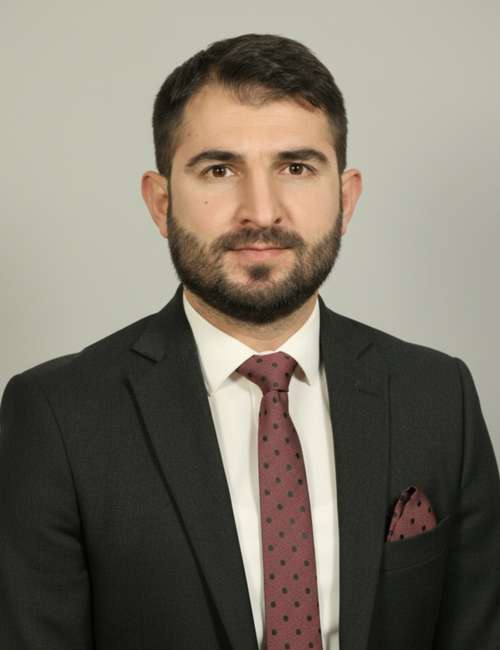
Academic Staff

May 19, 2026, 1:44 a.m.
Abdullah Hasan Jangeer (Master) Coordinator of DOIS CED
None
Assistant Lecturer in Fractional Differential Equations

Mathematics
College of Basic Education
University of Duhok

  • M Sc. in Fractional Differential Equations, College of Science, Eastern Mediterranean University, Cyprus, 2015.
  • B Sc. in Mathematics, College of Education, University of Zaakho, 2012.

Since 2015, I have developed extensive and sustained experience teaching a range of core mathematics subjects at the undergraduate level. Over the years, my teaching has encompassed Calculus, Linear Algebra, Foundation Mathematics, and both Ordinary and Partial Differential Equations. In addition, I have taught applied subjects such as Statistics using the SPSS program and computational methods through MATLAB. This combination of theoretical and applied courses has allowed me to support students with diverse academic needs and learning objectives.

Throughout my teaching career, I have focused on building strong conceptual understanding while also emphasizing problem-solving skills and practical application. In courses such as Calculus, Advanced Calculus and Linear Algebra, I have worked to ensure that students gain not only procedural fluency but also the ability to connect mathematical ideas to real-world contexts. My instruction in differential equations has similarly emphasized modeling, interpretation, and analytical techniques.

Teaching MATLAB and SPSS has provided opportunities to integrate technology into the learning process, helping students develop computational proficiency essential for modern scientific and engineering disciplines. By guiding learners through statistical analysis in SPSS and algorithmic thinking in MATLAB, I have contributed to their ability to apply mathematics in data-driven environments.

Across all these subjects, my commitment has been to create a supportive learning environment that encourages curiosity, critical thinking, and independent exploration. My teaching experience from 2015 to the present has strengthened my instructional skills and deepened my appreciation for the central role of mathematics in higher education and research.

Research

My research interests lie in the field of applied mathematics, with a particular focus on fractional differential equations, integral-type fractional Gronwall inequalities, and the broader area of dynamic mathematical systems. The motivation behind these interests stems from the growing importance of fractional calculus as a powerful tool for modeling complex phenomena that cannot be accurately described by classical integer-order models.

Fractional differential equations provide a flexible framework for capturing memory, hereditary properties, and nonlocal effects—features that arise naturally in fields such as physics, engineering, biology, and finance. My work aims to contribute to the theoretical development of such equations, focusing on existence, uniqueness, stability, and qualitative behavior of solutions. A central component of this research involves investigating fractional Gronwall-type inequalities, especially those of integral form, as they play a crucial role in establishing foundational estimates for fractional dynamical systems.

Additionally, I am interested in the study of dynamic mathematics in its broad sense, including stability theory, dynamical inequalities, and the analysis of nonlinear systems. By integrating techniques from fractional calculus with dynamic system theory, my research seeks to provide new mathematical tools that support robust modeling and deeper understanding of real-world processes.

Overall, my academic goal is to advance the theoretical underpinnings of fractional and dynamic mathematics while contributing methods and results that can be applied across scientific and engineering disciplines.

Since 2016, I have continuously supervised undergraduate mathematics projects, supporting students as they develop both their technical skills and their capacity for independent research. My supervision focuses on guiding students in formulating clear research questions, applying rigorous mathematical reasoning, and communicating their findings effectively.

Throughout these years, I have created a supportive environment that encourages inquiry, critical thinking, and academic integrity. This sustained commitment to mentorship has helped students gain confidence, deepen their understanding of mathematics, and successfully complete high-quality research projects.