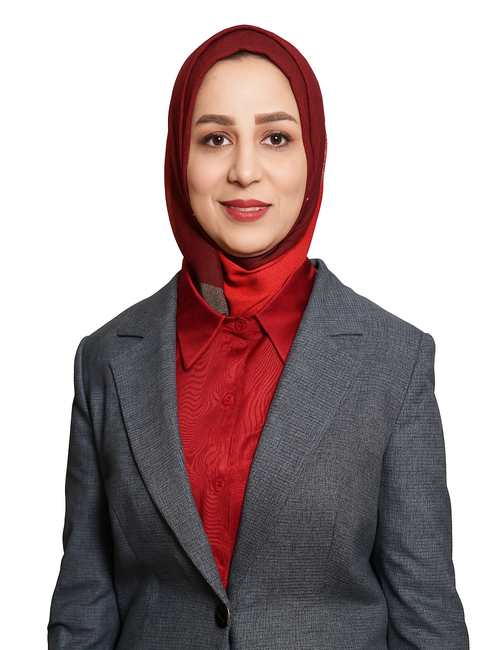
- PhD in Mathematics, Faculty of Science, Department of Mathematics, University of Zakho, 2023.
- MA in Mathematics, College of Computer Science and Mathematics, University of Mosul, 2010.
- BA in Mathematics, College of Computer Science and Mathematics, University of Mosul, 2006.
- Alsharari, F., Saleh, H. Y., & Taha, I. M. (2025). Some characterizations of k-fuzzy γ-open sets and fuzzy γ-continuity with further selected topics. Symmetry, 17(5), Article 678.
- Li, J., Saleh, H. Y., Salih, A. A., Rasheed, M. W., Bilal, M., & Shabbir, N. (2025). Fuzzy-based group decision-making approach utilizing a 2-tuple linguistic q-rung orthopair set for the selection of optimal watershed system model. Frontiers in Environmental Science, 12, Article 1502216.
- Rasheed, M. W., Saleh, H. Y., Salih, A. A., Karamat, J., & Bilal, M. (2025). An overview of pink eye infection to evaluate its medications: Group decision-making approach with 2-tuple linguistic T-spherical fuzzy WASPAS method. Frontiers in Artificial Intelligence, 7, Article 1496689.
- Saleh, H. Y., & Salih, A. A. (2024). c-Continuity, c-compact and c-separation axioms via soft sets. Neutrosophic Sets and Systems, 73(1), 51–64.
- Saleh, H. Y., Salih, A. A., Asaad, B. A., & Mohammed, R. A. (2024). Binary bipolar soft points and topology on binary bipolar soft sets with their symmetric properties. Symmetry, 16(1), Article 23.
- Alqahtani, M. H., & Saleh, H. Y. (2023). A novel class of separation axioms, compactness, and continuity via C-open sets. Mathematics, 11(23), Article 4729.
- Saleh, H. Y., Asaad, B. A., & Mohammed, R. A. (2023). Connectedness, local connectedness, and components on bipolar soft generalized topological spaces. Journal of Function Spaces, 2023, Article 6690462.
- Saleh, H. Y., Asaad, B. A., & Mohammed, R. A. (2022). Bipolar soft limit points in bipolar soft generalized topological spaces. Mathematics and Statistics, 10(6), 1264–1274.
- Saleh, H., Asaad, B., & Mohammed, R. (2022). Bipolar soft generalized topological structures and their application in decision making. European Journal of Pure and Applied Mathematics, 15(2), 646–671.
- Saleh, H. Y. (2018). Studying the characteristics of algebraic curve behavior for nonstandard method. Academic Journal of Nawroz University, 7(3), 82–84.
- Ismail, T. H., Saleh, H. Y., & Sulaiman, B. M. (2013). Some properties of convex galaxies and functions. Iraqi Journal of Statistical Sciences, 13(24), 22–33.
- 2011
- Ismail, T. H., & Saleh, H. Y. (2011). Characterizing internal and external sets. Iraqi Journal of Statistical Sciences, 11(20), 101–114.
- Ismail, T. H., & Saleh, H. Y. (2010a). Representation of a standard Lipschitzian functions by mean of microscope. Al-Rafiden Journal of Computer Sciences and Mathematics, 7(2), 163–172.
- Ismail, T. H., & Saleh, H. Y. (2010). Representation of standard continuous functions by mean of microscope. Al-Rafiden Journal of Computer Sciences and Mathematics, 7(1), 161–171.
Modeling Complexity and Uncertainty: An Interdisciplinary Approach to Advanced Topology and Analysis
The proposed research agenda is unified by a central goal: to construct robust mathematical frameworks capable of rigorously analyzing systems characterized by vagueness, incompleteness, and parametric dependence. This pursuit synthesizes core principles from Mathematical Analysis and General Topology with innovative extensions in set theory, notably Soft, Fuzzy, and Neutrosophic Sets, culminating in significant applications in Data and Graph Analysis and Decision Making.
The foundation of this research rests firmly in the classical rigor of Mathematical (Real) Analysis and General Topology. Analysis provides the tools for limits, continuity, and measure—the essential language for quantifying change and structure. Topology, in turn, offers the conceptual framework for understanding proximity, connectedness, and convergence, independent of specific metric distances. This classical bedrock is further augmented by an interest in Nonstandard Analysis, which provides an alternative, infinitesimally enriched approach to calculus and analysis, potentially yielding deeper insights into the structure of continuity and convergence within generalized topological spaces.
A critical evolution of this foundation is the focus on environments where classical sets fail to capture real-world ambiguities. This leads directly to the study of Soft Topological Spaces and Ideal Sets and Ideal Topological Spaces. Soft sets—the combination of a set of parameters and an approximate function mapping those parameters to subsets of the universe—offer a powerful mechanism for modeling parameterized uncertainty. When integrated with topology, they allow for the definition of continuity and separation in contexts where the structure is inherently parameter-dependent. Similarly, Ideal Topology addresses the notion of "small" or "negligible" sets, providing a formal structure to model imperfections or errors that might be ignored or treated specially within a space.
The necessity of handling multi-faceted uncertainty is addressed by the parallel interest in Fuzzy and Neutrosophic Sets. Fuzzy sets, which assign a degree of membership, model vagueness. Neutrosophic Sets extend this by explicitly handling three independent components: degree of membership, degree of indeterminacy (neutrality), and degree of non-membership, providing a superior model for highly complex, indeterminate systems. These modern set theories, especially in combination with the parametric flexibility of Soft and Hypersoft Sets, are instrumental in the development of practical algorithms for Decision Making. The research aims to translate the mathematical properties of these generalized topological structures into efficient mechanisms for evaluating alternatives under ambiguous conditions.
Finally, the research explicitly links theoretical developments to applied outcomes through Topological Applications in Data and Graph Analysis. The abstract concepts of connectedness and separation developed in Soft and Ideal Topologies are directly relevant to Topological Data Analysis (TDA), offering new metrics for clustering, dimension reduction, and shape classification of complex datasets. By leveraging these advanced topological tools, the research seeks to create flexible, mathematically grounded models for understanding the structural properties of real-world networks and data clouds, ultimately contributing to more accurate and robust analytical methods.
Since commencing academic teaching at the University of Duhok in 2011, this pedagogical portfolio demonstrates an extensive and robust commitment across pure mathematics, applied analysis, and modern set theory. This diverse instruction reflects a deep technical expertise, fostering students proficient in both classical mathematical rigor and contemporary research tools.
The foundation of this teaching expertise lies in rigorous, abstract analysis, providing the necessary theoretical rigor for all higher mathematics. Instructional experience covers cornerstone fields including Real Analysis, Mathematical Analysis, Complex Analysis, Functional Analysis, and Measure Theory. This core analytical strength is complemented by General Topology, which establishes the foundational concepts of abstract space and convergence, independent of specific metrics.
The teaching record also demonstrates versatility across structural and computational domains. This includes instruction in foundational disciplines like Calculus, Advanced Calculus, Algebra, and Geometry, alongside the critical structural course, Foundations of Mathematics, Logic & Set Theory. Furthermore, teaching Graph Theory effectively bridges pure mathematical structure with practical applications in network science and discrete optimization.
A distinctive strength is the sustained instruction in highly specialized, modern research areas that link directly to current academic work. Dedicated courses in Soft Set Theory and Fuzzy Set Theory are crucial for modeling complex, vague, and uncertain data. By teaching these topics, the instructor effectively grounds advanced theoretical research, exposing students to models explicitly designed to tackle complex decision-making challenges.
Moving forward, this extensive pedagogical background in core analysis, structural mathematics, and advanced set theories continues to serve as a vital asset. This versatility ensures the ongoing capacity to mentor the next generation of mathematicians, equipping them not only with mastery of the classical canon but also with the specialized, interdisciplinary tools necessary for immediate and impactful engagement with 21st-century mathematical research and complex real-world problem-solving.
The supervisory record demonstrates a comprehensive and active role in mentoring undergraduate students across essential and cutting-edge mathematical disciplines. This mentorship spans foundational abstract concepts, including Nonstandard Mathematical Analysis and the application of integral transforms like Laplace and Fourier Transforms, which equip students with powerful analytical tools. A strong specialization is evident in guiding students through advanced topological research, particularly in Ideal Topology and Primal Topology and the axiomatic definition of new types of open sets, which directly advances the core research agenda. Furthermore, a concentration of supervision in modern theories of uncertainty, such as Soft Sets, Bipolar Soft Sets, and Fuzzy Sets, trains future researchers in modeling complex, vague, and parametric data essential for decision-making. This holistic supervisory approach successfully develops highly skilled young mathematicians prepared to contribute to both theoretical mathematical advancements and real-world problem-solving.
A Holistic Commitment to Scholarship: Research Dissemination, Peer Review, and Institutional Engagement
Academic productivity is defined not solely by research output, but by active and multi-faceted engagement across the scientific ecosystem. The record of academic and scientific activities demonstrates a deep, integrated commitment encompassing high-impact research dissemination, essential scholarly service, and proactive institutional quality assurance.
Dissemination and International Engagement
A primary focus is the proactive dissemination of research findings at the highest levels. This commitment is highlighted by consistent activity in international fora, including the significant participation in the Mediterranean Conference on Neutrosophic Theory in Messina, Italy (2024). Presenting at such focused international conferences ensures research results—particularly in specialized areas like Neutrosophic Theory and generalized set theories—are exposed to rigorous international scrutiny and feedback. This is coupled with ongoing efforts to prepare, write, and edit research papers for publication in Scopus-indexed journals, underscoring a commitment to publishing work in high-quality, internationally recognized venues. Furthermore, regularly delivering lectures and research presentations in topology and soft set theory serves to communicate these complex concepts to wider academic and student audiences.
Scholarly Service and Collaboration
Integral to the scientific identity is the contribution to the quality and integrity of the field. This commitment is evidenced by actively reviewing research papers for international scientific journals. Serving as a peer reviewer recognizes the instructor as an expert whose judgment is trusted by international editors to evaluate the methodological soundness and originality of submitted manuscripts. This critical service function is complemented by sustained scientific collaboration with researchers both within Iraq and internationally, fostering joint projects that expand the scope and impact of the collective research program, particularly concerning complex modeling approaches in topology and set theory.
Institutional Development and Quality Assurance
Beyond external research activities, there is a dedicated focus on the quality and standards of the home institution. This internal commitment includes actively preparing academic quality assurance materials for the Department of Mathematics. This work is crucial for maintaining and enhancing pedagogical standards, ensuring that the department’s curriculum, assessment methods, and overall academic environment meet established national and international benchmarks for quality and rigor.
In summary, these activities reflect a well-rounded academic profile that successfully integrates the role of a research generator, a scholarly evaluator, and an institutional steward. This active participation across the entire academic spectrum reinforces the impact of the research and contributes directly to the vitality of both the departmental and the global mathematical community.